Showing posts with label school libraries. Show all posts

Sunday, August 23, 2026

Library Door Dash: When Students Can’t Get to the Library, Bring the Library to Them


A few days ago, I posted a photo of my Library Door Dash cart in two Facebook groups for school librarians with a very simple caption:

“My Library Door Dash is a big hit this year! 😃”


I expected a few likes and maybe a comment or two.

Instead, the two posts received hundreds of reactions and dozens of comments.

The most common response?

“Tell me more!”

Librarians wanted to know how students order books, when I make deliveries, whether teachers mind the interruption, how I handle snacks, how students return books, what happens if a student already has several books checked out, and—perhaps most importantly—whether this is something they could replicate at their own schools.

The answer to that last question is an enthusiastic YES.

And here's the best part:

Library Door Dash really isn't complicated.

At its core, the entire program is this:

Students search the library catalog, place a book on hold, and I deliver the checked-out book directly to their classroom.

That's it.

The cart, the cute sign, the stickers, the bookmarks, and the snacks make it fun.

But they aren't the reason Library Door Dash exists.

The reason is access.


The Problem: Students Can't Always Get to the Library

This is my fourth year offering Library Door Dash.

I originally started it because I kept running into a frustrating reality: students wanted books, but actually getting to the library wasn't always easy.

At the high school level, our classes are only about 45 minutes long. Sending a student across the building to browse the library can take a significant chunk out of instructional time.

My role also involves much more than sitting at a circulation desk. I work collaboratively with teachers and students in classrooms, and I do not have an adult library aide who can keep the library open when I'm somewhere else.

I've also worked between multiple campuses.

And now we can add construction to the equation.

This year, our books are housed in two different locations, my job responsibilities have expanded, and physical access to the library is even more limited and unpredictable.

There are mornings when I'm in the library.

There are lunch periods when students can come.

There are also days when the library is reserved for classes or our Somewhat Virtual Book Club, days when I'm co-teaching somewhere else, days when I'm at district meetings, and times when I'm working with confidential student data in a secure location where students cannot be present.

Without an adult library aide, I can't simply leave the library open when I'm somewhere else.

So I had to rethink the problem.

Instead of asking:

How do I get more students into the library?

I started asking:

How do I get more library books into students' hands?

If students can't always come to the library, then sometimes the library needs to go to them.

Enter Library Door Dash.


How Students Order a Book

We use Destiny Discover, so I didn't create another Google Form, app, website, or complicated ordering system.

Students already have access to Destiny.

They simply:

  1. Open Destiny Discover.
  2. Search for a book.
  3. Place the book on hold.

That's their entire part of the process.

Students can access Library Door Dash through our Student Library Canvas course.
The Door Dash link directs them to Destiny Discover,
where they search the collection and place books on hold.


I also provide students with instructions in our Canvas course showing them how to access Destiny Discover and place a hold.

Students receive simple directions for accessing Destiny Discover, searching the catalog, and placing books on hold.


No special Door Dash software required.

If your library already allows students to place holds through your catalog, you may already have most of the infrastructure you need.


What Happens After a Student Places a Hold?

That's when the Door Dash magic begins.

I check Destiny for holds throughout the day whenever I have an opportunity.

There is not a guaranteed same-day delivery.

That is important.

Library Door Dash works around my existing responsibilities—not the other way around.

When I see a new hold, I:

  • Pull the requested book.
  • Write the student's name on a Post-it note.
  • Locate the student's ID number.
  • Check the book out to the student.
  • Look up the student's schedule in our student information system.
  • Write the classroom information on the Post-it.
  • Add a bookmark.
  • Add a sticker.
  • Organize the books on my cart by classroom number.

Once everything is ready, I make my delivery run.

Before heading out, requested books are checked out and organized by classroom.
Post-it notes help me keep track of student and delivery information.


The Post-it system isn't glamorous.

It is, however, highly effective.

And sometimes that's the best kind of library technology. 😂


When Do I Make Deliveries?

Whenever I have time.

Seriously.

I deliver when I'm not working with teachers in classrooms, handling EdTech responsibilities, working with data, attending meetings, or doing one of the approximately 4,872 other things school librarians somehow do during a normal day.

When possible, I prefer delivering later in the day—usually during 8th or 9th period.

Students understand that placing a hold doesn't mean I'm going to appear five minutes later.

Library Door Dash is not Amazon Prime.

There is no guaranteed two-hour shipping window. 😂

But when I have a collection of books ready and a few minutes available, I load the cart and start making my rounds.


Do Teachers Mind You Interrupting Class?

This was one of the questions several librarians asked.

So far?

Not at all.

I've never had a teacher complain.

In fact, teachers seem to genuinely enjoy seeing a student get excited about receiving a library book.

The delivery itself takes seconds.

I pop in, hand the student the book, and move along.

Occasionally a teacher looks at the snack bin and asks:

“Do I get a treat?”

Of course.

Teachers get treats too.

And sometimes a cute sticker.

I'm not a monster. 😂


About Those Snacks...

Judging from the Facebook comments, I may have accidentally created Library Snack Dash Featuring Books.

People had questions.

Every student delivery currently includes:

  • 📚 Their checked-out library book
  • 🔖 A bookmark
  • ✨ A sticker
  • 🍬 A snack

I make many of the stickers myself using my Cricut. To start this school year, I've made special Hutto Hippo stickers for students.

I make many of the Library Door Dash stickers myself using Cricut Design Space.
These Hutto Hippo stickers were created especially for students to kick off the new school year.


Bookmarks and sticker supplies come from my library budget.

The snacks?

Unfortunately, those usually come from the Bank of Dr. G.

I watch for sales.

I snatch up giant bags of holiday candy.

Halloween clearance is my friend.

Costco is dangerous.

You get the idea.

The extras make deliveries fun, but they aren't required.
Students can choose from a variety of snacks,
and each book includes a bookmark and sticker.

I also want to be very clear about something:

You do NOT have to provide snacks.

Please don't look at my cart and think implementing this program requires personally feeding your entire student body.

It doesn't.

Students also don't have to take a snack, and I try to provide different options because students have different needs and preferences.

The snack is a bonus.

The book is the point.

If your version of Library Door Dash consists of a student receiving a library book and a smile, you have successfully implemented Library Door Dash.


You Don't Need a Special Cart

Another misconception I want to clear up:

My Library Door Dash cart is just a regular library book cart.

You know the kind.

The same metal cart librarians everywhere have pushed approximately 6.3 million miles while muttering, “Who put all these books on the wrong shelf?”

I simply repurposed mine.

I've added signage, containers for snacks, and organizational pieces, but the cart itself isn't what makes the program successful.

You could use:

  • A library cart
  • A rolling crate
  • A basket
  • A tote bag
  • A wagon
  • A backpack

The delivery method should fit your building and your situation.

The cart isn't the program.

Access is the program.


What About Students Who Already Have Books Checked Out?

At the high school level, I don't have a specific maximum number of books students can check out.

I would much rather have the problem of a student checking out too many books than the problem of a student being unable to get one.

That said, if I notice someone starting their own unauthorized branch library with half my collection, we have a conversation.

Usually something along the lines of:

“You need to bring some books back before I have to cut you off.”

I've also been known to say:

“Don't be greedy.”

😂

Every library can adapt this part of the process according to its own circulation policies.


How Do Students Return Their Books?

Students do not need to wait until the library is open to return books.

We have a book return drop box outside the second-floor library.

Students can return books even when the library isn't open for
browsing by using the book drop outside the library.


This is another important piece of access.

Students can request books digitally.

I can deliver them physically.

They can return them independently.

The entire process does not depend on the library doors being open at the exact moment a student has free time.


But Shouldn't Students Come to the Library and Browse?

One librarian raised a thoughtful question in the Facebook discussion:

If we're delivering books directly to students, are students missing opportunities to browse shelves and learn how the library is organized?

It's a fair question.

My answer is:

Library Door Dash is an additional access point—not a replacement for the library.

I absolutely want students in the library.

I want them browsing.

I want them picking up one book and discovering another book sitting next to it.

I want them asking for recommendations.

I want them learning how libraries work.

But the reality is that access isn't always available when students need it.

In my current position as an EdTech, Data, and Media Specialist, I am not physically in the student library all day.

I'm available there in the mornings and during some lunch periods, but even lunch access varies based on programming, classes using the space, meetings, co-teaching responsibilities, and other parts of my job.

So sometimes the choice isn't:

Door Dash OR visiting the library.

Sometimes the actual choice is:

Door Dash OR the student doesn't get the book.

In that situation?

I'm delivering the book.

Every time.


Construction Made Door Dash Even More Important

This year our collection is divided between two locations.

That is inconvenient for me.

It shouldn't have to be inconvenient for students.

From the student's perspective, there is still one library collection.

They search Destiny.

They place a hold.

Then I figure out where the book physically lives.

Students shouldn't need a construction map, GPS coordinates, and a treasure hunt clue to find a library book.

That's my job.

Door Dash makes the physical location of the book almost invisible to the student.

They ask for it.

I find it.

They get it.


Other Librarians Are Doing This Too—and They Have Great Ideas

One of my favorite parts of sharing Library Door Dash in librarian Facebook groups was discovering how many other librarians have created their own versions of book delivery.

And, as librarians tend to do, they immediately started sharing ideas.

UberReads

Michelle Renae Smith shared that she has operated a similar service for several years called UberReads.

Students contact her, receive the circulation link, choose what they want, and receive their books in a gift bag with extras such as tissue paper, stickers, fidget toys, candy, and bookmarks.

I love the idea of making the delivery itself feel like receiving a gift.

Book Drop

Jennifer Nichols Eldridge shared her version, called Book Drop.

She bags requested books and has student aides deliver them to classrooms.

That is a fantastic adaptation for librarians who have student workers but don't have time to personally make every delivery.

Sometimes All You Need Is a Bag

Ashley Kuch shared that during COVID she delivered books to students in a canvas bag.

She worked on the bottom floor of a four-story building without an elevator, so a giant delivery setup simply wasn't practical.

Her comment reinforced something important:

Do not copy my cart. Copy the concept.

Make it work in your space.

Make the Service Visible

Elizabeth Hadwin shared that she already works with students on placing holds, but they sometimes forget about them after rotating to their next classes.

She loved the idea of using signage and a visible cart to make the service more memorable.

That's a great point.

The cart doesn't just move books.

It advertises reading while it moves through the school.

You May Already Have What You Need

Cynthia Clouse Matheson noted that her library already uses Destiny holds, so implementing something similar seemed completely doable.

Exactly.

You don't necessarily need:

  • Another app
  • Another form
  • Another subscription
  • Another platform

You may already have the technology.

You just need a delivery plan.


Want to Start Your Own Library Door Dash?

Start simple.

What You Actually Need

Required:

  • A searchable library catalog
  • A way for students to request books
  • A way to identify the student's location
  • A circulation system
  • Something to carry the books

That's really it.

Nice to Have

  • A catchy program name
  • A Canva sign
  • A decorated cart
  • Bookmarks
  • Stickers
  • Snacks
  • Student aides
  • A designated delivery time

Those things add personality.

They aren't what makes the program work.

You could deliver books twice a week.

You could have student aides make deliveries.

You could use lunch periods.

You could create a pickup location.

You could skip snacks entirely.

You could deliver books in grocery bags.

Make the program fit:

your school + your students + your staffing + your schedule.


Doesn't This Create More Work?

Yes.

Absolutely.

Pulling books takes time.

Checking books out takes time.

Looking up student schedules takes time.

Organizing deliveries takes time.

Walking around the building takes time.

But librarians make decisions every day about where our time has the greatest impact.

For me, getting books into students' hands is worth the time.

I don't have three years of beautifully organized spreadsheets proving that Library Door Dash increased circulation by 42.7 percent.

That wasn't why I created it.

My goal was much simpler:

Get books to kids.


The Unexpected Benefit: Door Dash Is Reading Advocacy

Here's something I didn't fully anticipate when I started this.

When you roll a brightly labeled book cart into a classroom and announce:

“I have a Library Door Dash delivery!”

people notice.

The student receiving the book gets excited.

The student sitting next to them looks at the cover.

Someone asks what they ordered.

Someone else asks:

“How do I get one?”

Suddenly, a completely ordinary library transaction becomes visible.

Receiving a book feels a little special.

The delivery becomes a mini reading advertisement every time I walk into a classroom.

That's powerful.

Because sometimes the best way to promote the library isn't waiting for students to walk through the door.

Sometimes it's rolling down the hallway toward them.


The Bigger Idea

Library Door Dash may look like a cute cart filled with books, candy, bookmarks, and stickers.

But that isn't really what it is.

It's an answer to a larger question:

How can we remove barriers between students and books?

Maybe your answer is extended library hours.

Maybe it's flexible scheduling.

Maybe it's eBooks.

Maybe it's classroom collections.

Maybe it's curbside pickup.

Maybe it's student delivery aides.

And maybe...

you put the books on a cart and go find the kids.

Because ultimately, my goal isn't simply getting students through the library door.

My goal is getting books into their hands.

And if I have to Door Dash them there?

I'm happy to make the delivery. 📚🚚


AI Use Disclosure

In the spirit of transparency and responsible AI use, I used ChatGPT to help brainstorm the AI in 10 concept and branding, organize the ideas in this post, and revise portions of the writing for clarity and flow. I reviewed, edited, and approved the final content. The experiences, instructional decisions, examples, and opinions shared here are my own.




Tuesday, August 3, 2021

2021-2022 Back-To-School Time in the Library

It is back-to-school time and that means looking forward and planning for great activities for our students whether we are in person, virtual, or a hybrid model. In 2019 Shannon Miller created a wonderful Google Sheet, “Library, Learning and Literacy Celebrations Throughout The Year!”, that provides dates of monthly celebrations, resources, curricular tie-ins, display and bulletin board ideas, web links, and more. While this resource is “out of date” and some links are no longer valid, it still provides a jumping-off place for planning library activities. I’d also encourage you to keep an eye on Shannon’s blog for new lessons, choice boards, and collaborative ideas. 


Two of my favorite dates in September for the Elementary level are International Dot Day and Talk Like a Pirate Day. While it isn’t mandatory to sign up to participate in International Dot Day to create activities for your students, I would recommend doing so. Signing up will enable access to the free Educators’ Handbook for International Dot Day that is filled with many learning activities and blackline masters. Shannon Miller has also created a new STE(A)M Choice Board exclusively for International Dot Day. In addition, Discovery Education has an entire channel dedicated to International Dot Day. One of my favorite Discovery Education Dot Day resources is the virtual field trip. 


Kids love pirates and pretending! Sandy Kendell, a  digital learning coach in Texas at Georgetown ISD, wrote a blog post with seven fun ideas to celebrate Talk Like a Pirate Day with your students. Of course, my favorite of the seven ideas Sandy suggests is pulling out all of the pirate books in your library collection.  Melinda Long and David Shannon team up to write some of my favorite pirate books, including Pirates Don’t Change Diapers. Similar to their International Dot Day channel, Discovery Education has a channel dedicated to Pirates as well. Access the EBSCO eBooks K-8 collection through TexQuest to provide your students with virtual access to pirate books as well. Talk Like a Pirate Day is also the perfect time to introduce your students to the Story Pirates! The Story Pirates is an award-winning Podcast that takes stories written by students just like yours and turns them into sketch comedy and songs. You might also want to check out some of the YouTube videos created by the Story Pirates as well. They are always good for a big belly laugh! The Story Pirates are a great motivating tool to get students excited about creative writing. 


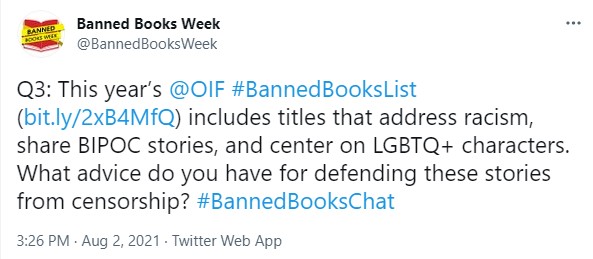
At the High School level, my September focus is on Banned Books Week and Library Card Signup Month. The theme for this year’s Banned Books Week is Books Unite Us, Censorship Divides Us. Jason Reynolds, Inaugural Honorary Chair of Banned Books Week, participated in a Twitter chat, #BannedBooksChat, on August 2, 2021. The chat is full of information about how librarians (and more) observe Banned Books Week in their schools. Question #3 of the #BannedBooksChat is a reminder that all school librarians need to review their requests for reconsideration policies and procedures should a book challenge arise. 


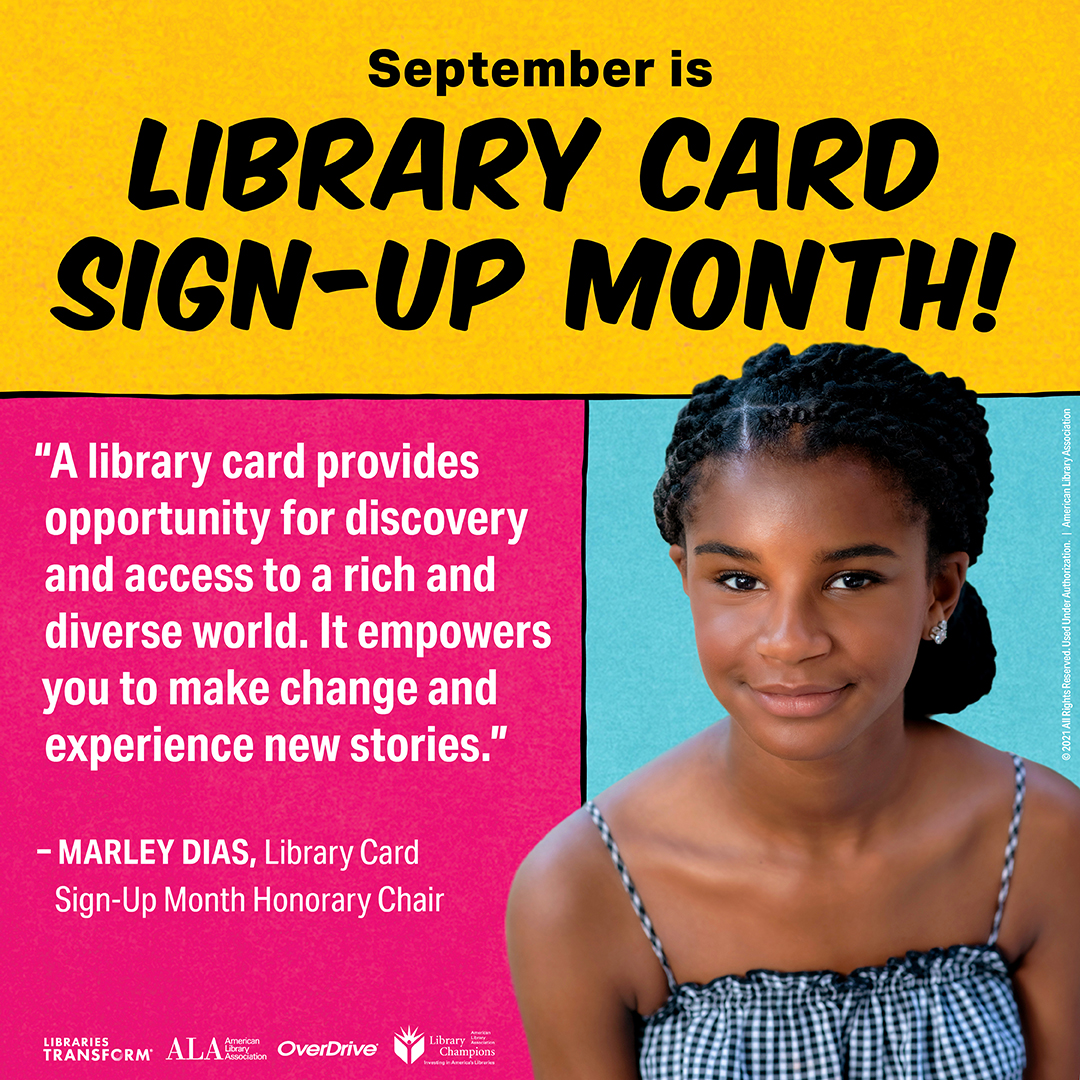
September is also the perfect time to partner with your public library for Library Card Signup Month. Many public libraries will come to your school and allow students to sign up for a public library card. Marley Davis, author, executive producer, and founder of #1000BlackGirlBooks is the honorary chair this year. It makes my heart sing to see her in this role! 


Although we have just dipped our toes into August the #LibraryCardSignUpMonth on Twitter is already generating buzz. Use #LibraryCardSignUpMonth on Twitter to access ideas from September 2020.  The American Library Association has provided free, downloadable, social media headers, covers, for you to use all month long. 


No matter the month, a visit to the library is always a reason to celebrate!


Sunday, October 13, 2019

Follett Webinar Recap: Fighting Back: Making the Case for a Certified Librarian


*Cross-post with Follett


Recently I had the pleasure of partnering with Follett and John Chrastka, executive director of EveryLibrary, to present a timely and relevant webinar, Fighting Back: Making the Case for a Certified Librarian. In the weeks leading up to the webinar, Follett sent out a survey to registered participants to elicit questions they would like addressed in the overarching theme of library advocacy. Based on response data three main areas of focus were, Making the Case, Writing the Plan, and Annual Report, followed by some ProTips and Q&A.

Making the Case

An overwhelming hurdle for school librarians is being able to effectively disseminate the critically vital impact a full time certified library media specialist has on student outcomes. The American Association of School Librarians created a research-based, fact-filled, yet easily digestible infographic titled, Strong School Libraries Build Strong Students, that can be shared with your principals and superintendent as well as providing talking points when the worth of your position is called into question. For a deeper dive into the research, you can turn to the Phi Delta Kappan journal article, Why school libraries matter: What years of research tell us.

Data, however, doesn’t hold much water if there is no tangible action from the librarians within schools and districts backing it up. Often times we, certified librarians, shoot ourselves (and subsequently others) in the foot as one registered participant stated in the pre-webinar survey, “Past certified librarians became lackadaisical near retirement giving a bad name to the rest of us. Their replacements are all paraprofessionals. How do you suggest approaching key decisionmakers about this dilemma?”

Writing the Plan

Advocating for your school library goes beyond just vocalizing your concerns, needs, wants, and “should be”. A thoughtful and thorough plan needs to be written up that includes a specific cause or goal supported with data that clearly connects the dots back to student outcomes. The “who” needs to be clearly defined as well so that your message will resonate with the critical needs of the stakeholder your advocacy is addressing. If designing this message for the administration, focus on how your cause or goal supports the school mission, vision, and values, how it ties to student outcomes and addresses those issues that keep your administrators up at night. Additionally, have a viable action plan for implementation.

Annual Reports

Annual reports are a bit different from your written plan but can and should draw from it. An annual report tells the story of the library, specifically how the work you do makes a difference and is connected to positive student outcomes with data to back it up. Jennifer LaGarde’s post, It’s Annual Report Season! Here Are Some Tips To Help You Effectively Tell Your Story, provides a detailed framework on how best to approach the creation and delivery of an Annual Report. Key components of Jennifer’s post include identifying your target audience, including student data as opposed to circulation data, tell a story, share both qualitative and quantitative data to diversify the information shared, start early gathering information throughout the school year, ensure that the Annual Plan is easily digestible and respects the time of your target audience, let the Annual Report be a mirror on the work you do, and learn from others. Jennifer has also included an open-source Google Doc where you can view a wide variety of Annual Reports created by school librarians across the country.

Don’t wait until the end of the year and Annual Report time to share the story of your library. It is also helpful to harness the power of social media to share the story of how the school library is impacting student learning and teacher effectiveness each day throughout the year. Social media is also convenient storage of the stories you will later share in your Annual Report. In my book, Connected Librarians: Tap Social Media to Enhance Professional Development and Student Learning, my own personal journey and concrete examples of how social media can tell your story, build connections, provide rich professional development, and connect your school with the world for global collaboration and real-world connections. It also helps make the case for social media if your administration is hesitant.


ProTips

Dr. Laura Sheneman, founder of the Librarian Influencers website and the Librarians Influencers Podcast, provides a free How-to Guide Elevator Talk Worksheet to accompany the blog post, Create an Elevator Speech You Can Recycle Many Ways. A ready to use elevator speech helps let others who inquire what you do as a librarian and why what you do matters. Laura guides you through examining the Common Beliefs of the AASL Standards, your school and district vision and mission statements, digging deep into core values, and development of a memorable tagline. Laura even provides example elevator talks for situations such as a school open house, a school board meeting, or being interviewed by a local radio or television station. I often find myself in need of an elevator pitch when meeting new people just in general social situations in my private life who often espouse they are surprised there is a need for librarians now that schools have computers.

Perhaps the most important thing you can do to advocate for school libraries is to conduct your library services in such a way that administrators, teachers, students, parents, and community members can’t possibly imagine the school functioning effectively without you.


Saturday, August 4, 2018

4 Back to School Tips for New (and not so new) School Librarians

*This is the unedited version written for School Library Journal


Four Tips For New (or new to the school) Librarians

Congratulations on your new job as a school librarian! It is hands down the absolutely best job...EVER!  Last year, entering my twenty-sixth year as an educator and twenty-first year as a school librarian, I found myself in the position of bring a new librarian in quite a few ways.  I retired from Alabama and moved to Texas for an awesome school library position to work for an administrator for whom I have great respect and admiration. I moved from working at a high school library for the past twelve years to working at an elementary school. I moved from having a flexible schedule to a fixed schedule as part of the Specials rotation with Art, Music, and PE. I moved from having amazing, full time library aides to having no full time aide. I changed from having no district library supervisor to having and incredibly supportive one. I moved from not having a unified district library structure to having a very well structured program. So much was all new to me! Below are four tips to help you as you enter this new chapter of your life.

Get Connected

Being a school librarian can be a shockingly isolating profession, especially after having formed tight, supportive networks while you were a classroom teacher.  As a school librarian you are in a sort of no man’s land. You aren’t part of the teacher peer group, you aren’t part of the administrative peer group. Often, you are the only person in your school that works in and understands what it takes to run an active, engaging, supportive library.  Many school districts, unfortunately, often perpetuate this isolation by not allowing time for district librarians to meet and plan collaboratively which only exacerbates the isolation.

FIND YOUR PEOPLE
Don’t wait around for your district to connect you. Reach out to the other librarians in your district and find out what you have in common. Maybe your children both play softball, go to gymnastics, or dance class. Perhaps you could set up playdates, or other social interactions to get together outside the school day.  My favorite since my children are grown and out of the house is to set up weekend brunch/lunch meetings or after school dinner meetings. Talk, have fun, swap ideas and plan. Plus, it’s fun to have time away with friends who really get each other. Don’t stop there. Connecting with librarians outside of your school, district, and state, and country brings a unique worldview into your library program and enriches student learning.

Where To Find Your People
  • Twitter

Twitter is one of the best places you can go to connect, share, learn and grow with other school librarians and connected educators. Twitter is how I went from being a burned out educator to feeling like I never want to do anything else but teach.  Teaching before Twitter was lonely, frustrating, and boring. Teaching with Twitter is energizing, invigorating, fun, creative, and I never want to get off this ride of bringing awesome learning opportunities to my students and teachers.

There are a few secrets to truly harnessing the power of Twitter.  

  • Hashtags: 
    • By following, commenting, sharing, and connecting using hashtags you will      maximize your own professional learning.  
    • Three hashtags I’d recommend for school librarians are:
      • #TLChat
      • #FutureReadyLibs
      • #ISTELib

Don’t limit yourself to just these hashtags. Make sure to connect using state education hashtags, makerspace hashtags, and educational technology hashtags as well.

  • Twitter Chats: Twitter chats are the scheduled conversations, usually in a Q/A format lead by a moderator or moderators that take place on a weekly or monthly basis.


Two places to find hashtags for you, your teachers, and administrators are:


  • Facebook Groups
        Facebook is a great place to join groups to connect, learn, grow and share with other school
librarians and innovative educators. A few of my favorite Facebook Groups include:

  • Professional Development Resources for School Librarians

Below are a few professional development resources where you can find your people and have official professional development at the same time.


I owe my much of my success to my PLN. Without their strength, support, guidance, ideas and more I would not be able to accomplish so many of my professional and personal goals.  Through social media connections I have developed true friendships with other librarians and educators who will cry with you and lift you up when you are struggling and laugh, dance, and celebrate with you when you are successful.


Be fearless even if you are trembling on the inside.  Be the one who demonstrates that it is ok to not know something but be willing to learn, fail, and start again. We need to model for both our students and our teachers the willingness to not know everything and the need to not control everything.  

While I am in no way a fan of being on a fixed schedule as part of the Specials rotation, was awesome to have a captive audience to try out new ideas garnered through my incredible and diverse PLN (Professional Learning Network).  I loved learning about a new technology, app, website, craft, and more and knowing that I could go into work the next day and try it out with the kids even if I didn’t really know how to do it myself. Part of the fun was learning right along with the students and letting them teach me!

We also need to assist our teachers with expanding collaboration beyond the school building to forge authentic real world learning opportunities with others across the country and around the world using video conferencing tools like Google Hangouts, YouTube Live, and Skype. Events like Read Across America, World Read Aloud Day, International Dot Day, Andy Plemmons’ Picture Book Smackdown, Elissa Malespina’s virtual debates, Stony Evans’ #StonyStories empowering students to be in house PD and national presenters, National Poetry Month/Poem in Your Pocket Day, Mystery Skype, and so many more events can be made exponentially better by connecting with other schools celebrating or doing the same things.  I love that Shannon Miller put together a Google Document this past year where we can all share monthly Library Celebrations, any of which could be made collaborative.  

One new technology I want to use this year is #GridPals via FlipGrid. I introduced my students and school to FlipGrid during my first year.  Students, teachers, administrators, and parents could all contribute to our two FlipGrid topics; Book of the Day and Quote of the Day.  These grids were then incorporated into our morning news show. That way the whole school community had an opportunity to be part of the morning announcements.  

This year I want to connect my students through the new #Gridpals program. While FlipGrid has a Google Form where you can connect your students with other students around the world, you can always team up with another teacher or teachers you know to do something similar on your own.

I challenge you this year to be fearless! Part of being fearless is stepping out and trying new things even if you have never tried them before.  The willingness to learn and put yourself out there even if failure ensues (and it will) is the most fearless thing you can do!


Entering a brand new chapter as a school librarian I set an impossibly high bar for myself in part because I knew what I had been able to do in my past schools.  I failed to take into account all of the supports that I had in place in my old schools that I no longer had in my new school; a full time aide, a flexible schedule, student library aide (a great high school perk), and more.  

I worked myself at a frenzied pace to try to meet my own unrealistic goals. I weeded a collection that had not been weeded properly in twelve years with the help of my new district library supervisor, Becky Calzada. I genrefied the collection. I ripped shelving off the walls, moved and discarded furniture, and took apart and rearranged the circulation desk. I started a morning news show for our school’s morning announcements. I created makespace style centers and introduced cool new technologies to the kids like green screens, robotics, coding, and more. My third through fifth grade students created and maintained digital portfolios.

I found myself working all night at home and all weekend just to keep up with all the tasks I had heaped on my professional plate. I was exhausted, frustrated, angry, and after just the first year at my new school I was quickly moving into burnout mode.

Then I talked to my library hero and mentor, Jennifer Lagarde.  After attentively listening to my woes she said, “What advice would you give another librarian if they were saying these same things to you?”  Jennifer also asked, “Would you talk to another librarian the way you are talking to yourself?” Wow! Jennifer’s words really made me stop and think.  

I would advise another librarian to choose just one goal for each school year and concentrate on that. I’d also say, “Give yourself a break. Celebrate the cool things you are doing rather than beating yourself up over the things you aren’t doing.”  Being a connected educator is great for ideas and support from people who “get you” but can also make you feel as if you aren’t doing enough. As long as students are your main focus you are moving in the right direction. You are not a superhero. You are a beautiful, wonderful, talented human being with much to offer to your new students, staff, administrators, parents, and community members.


Make Community Connections

The PTA, parents, and grandparents this first year in Texas were my saving grace. I was so fortunate to have an involved and supportive PTA.  They took charge of the first Scholastic Book Fair of two booked by the previous librarian for the school year. I still felt as if I was drowning when that first book fair came around and couldn’t have possibly done it without them.

I was also blessed with some pretty incredible parent and grandparent volunteers.  With over 800 students and a tight back to back fixed schedule the ability to just shelve books was overwhelming.  My two grandparent volunteers, Ms. Gloria and Ms. Jean came every Tuesday and Thursday to shelve books. Whew! If it weren’t for them I would be buried under piles of books.  Ms. Phan, Ms. Bercu, Ms. Roberts, and Ms. Williams were also great helpers, often coming in to shelve books but also to help out with our library center activities.

My new school also hosted a WatchDog Dads program. My very basic understanding of the program is that the dads come to school with their kids and help out where needed but also spend time with their kids in class.  Just at moments when I thought I would just curl up into a ball and start crying, a WatchDog Dad would walk into the library and save me. One day in particular the Internet went out which meant my book checkout system was down as were most of my center activities. I was frantically trying to devise a plan when three WatchDog Dads walked into the library. Together we quickly came up with a plan of action and the day was saved!

My principal and front office staff also helped me out by sending substitute teachers to the library whenever they had a planning period on their schedule. I liked this because I could learn more about the school and community by talking and making friends with them. I can’t believe I went 25 years without knowing you could have substitutes help out like that!

Final Thoughts

More than any other advice I can give I think the most important things you can do as a new librarian is have fun, don’t take yourself too seriously, and always put serving others with joy (even when you don’t feel joyful) before all other tasks (management tasks can wait...people are more important).