Friday, September 15, 2023

NGC Library LitBox Subscription Program


I learned about the LitBox subscription program at the April 2023 Texas Library Association Conference in a session presented by Morgan Green-Griffin. Morgan was the recipient of the 2022 Young Adult Reading Incentive (YARI) Award for the Teen LitBox subscription program she developed for 6th- 12th graders at the public library of Coppell, TX.

The LitBox subscription is similar to a BarkBox or other monthly subscription service. Like BarkBox the contents of the LitBox match the theme of the month. Each LitBox contains one to two books, an informative trifold brochure, and some swag and goodies.


Because of a limited budget and because I was unsure about how the LitBox program would be received by students, I chose to limit the number of NGC LitBoxes to 10 per month. On August 28, 2023, I sent out an informative flyer about the NGC LitBox subscription program and the subscription form for September using the Announcements feature of the NGC Library Canvas course. Nine students (with a little arm twisting from me) signed up to receive the very first ever NGC LitBoxes. I expect more students will sign up to receive an NGC LitBox now that they have seen what a LitBox actually is. 


The theme for the September NGC LitBox was Hispanic Heritage Month. Included in each box were two books, an informative Hispanic Heritage Month trifold brochure, Lucas Skwinkles Salsagheti, Mexistuff stickers by Efrain Tinoco, and an Amate art kit (bark paper, acrylic paint set, information about the history of and how to make Amate Art, and a glitter pencil). 


How did I choose the books?

During library orientation, students completed a Reading Genre Personality Quiz. Using their answers I found books that fell within the theme of Hispanic Heritage Month and that also matched their reading personality.


How did I create the informative trifold brochure?

I created the informative trifold brochure by slightly editing the one created by Morgan Green-Griffin. Morgan was quite generous and provided me with editable copies of all of the LitBox brochures she created in Canva! 


How did I choose what swag and treats to include in the NGC LitBox?

I looked at what Morgan Green-Griffin included in her LitBoxes and duplicated or substituted items while remaining true to the theme.


How do you pick which students get the NGC LitBox?

Students who are interested in receiving an NGC LitBox must subscribe every month. Students who receive an NGC LitBox must submit a brief book review to be eligible to receive any future NGC LitBoxes. The first 10 students who subscribe and meet the eligibility requirements will receive the NGC LitBox for that month.


What will be in the October NGC LitBox?

The theme for the October NGC LitBox is SPOOKY! The box will include two books from our library collection, an informational trifold brochure, a costume, scary coloring sheets, spooky buttons & stickers, and treats. 

24-25 UPDATES

October NGC LitBox 2024:

  • Organizing LitBoxes each month is a detailed process:
  • Plan the topic/theme for the month
  • Design the tri-fold brochure
  • Decide the “swag” needed for each month
  • Ordering or soliciting “swag” items
  • Create a Google Form for students to register for the LitBox
  • Create and schedule an announcement in Canvas announcing registration is now open
  • Review each student's Genre Personality to match books with the student and the theme
  • Checking student’s checkout history
  • Pull two books that match the Genre Personality and the theme for the LitBox month for each student
  • Check books out through Destiny for each student
  • Design, print, and fold the LitBox informational brochure
  • Fold boxes, pack with tissue paper, and pack all the LitBox items
  • Look up 8th period room numbers for each student
  • Deliver LitBoxes to students

Amanda Chacon started her litbox program this year. Instead of using library books from her collection, Amanda purchased books for students to keep. I love this idea! Callie Dawson, my district's high school librarian and lead librarian, did this type of litbox last year.


2024-2025 NGC LitBox Themes:

September: Graphic Novels and Manga

October: Spooky

November: Kindness

December: I Survived!

January: New Year, Sustainable You

February: Kaleidoscope of Diverse Joy

March: Seeds of Strength: Women's History in Full Bloom

April: Chill Vibes Only: Your Stress-Free Survival Kit

May: Animal Antics

What questions do you have for me?


Questions from Readers:

From the Future Ready Librarians' Facebook Group: I have a question about funding the Litboxes.

How do I pay for the items in the NGC LitBoxes?

This school year (23-24), I purchased most of the items myself, through donations, or with Library Supply funds. Morgan Green-Griffin did quite a bit of community outreach asking for donations. The items included in the December LitBox were almost entirely supplied by the Hutto, TX Department of Emergency Management, Police Department, Fire Department, and the Department of City Services. Next school year I plan to seek more community support. 


Friday, July 28, 2023

Using Your District LMS to Reach Students and Teachers


I don't know about you, but I haven't had much success getting traction on the district's library webpage. Even in the best situations, it can be clunky, and many extra steps for your students and teachers to navigate.

Last year I decided to use the district's library webpage as a type of launching space to direct students and teachers to the Canvas course I built specifically for the library. I chose to use Canvas since this is where students and teachers go every day to access their coursework. The library Canvas course includes all of our library resources plus fun activities and announcements. The response last year was phenomenal!

This year I have added new information, resources, and reading programs to the library Canvas course.  To keep the library Canvas course front and center, I have created a daily schedule of Canvas library announcements to inform and encourage engagement.

Below is a video tour of the library Canvas course for students.


Tuesday, July 11, 2023

Beat the Clock: A Library Orientation Tale


I have been beating my head against a brick wall trying to figure out how best to approach Library Orientation for the 2023-2024 school year. I've come up with quite a few plans but have always been left with a nagging worry in the back of my mind about each plan.


Then my friend, Elissa Malespina, sent a text asking for the link to my Personal Shopper Google Form. This simple request finally made everything click! I think I now have a feasible plan that will keep my sanity intact and chaos to a minimum. 


Let me start by stating that, ideally, this is NOT the library orientation I want to do. In the past, my favorite library orientations have been physical escape room orientations. Escape room orientations worked well in a block schedule with 90 minutes per class.


This year, I will only have, at best, 30 minutes with each English class for a physical visit to the library for orientation. Trying to do any activity like a scavenger hunt, escape room, centers, etc., with only 5 minutes between classes to clean up and regroup simply isn't feasible. 


Taking this information into consideration, my library orientation plan will happen in two parts, virtual and physical. The Virtual Library Orientation will include:
  •  Zoom sessions with all of the English classes simultaneously to talk about the library "basics." 
  • The last "basics" slide will lead students to the Library Orientation section in their Library Canvas course. 

Once they are in the "Library Orientation" section in their Library Canvas course, I'll ask them to write their answers down on paper as I go through the Reading Genre Quiz slide by slide with them.


Next, I'll ask students to click on the "key to score their answers" button found in the Library Orientation section in their Library Canvas course. 


Lastly, students will click on the link provided on the second slide of the "key to score their answers" document. This link takes them to a Google Form, where they will submit their answers and answer a few other questions about their reading preferences.


The Physical Library Orientation will have two activities:
  • Checking out books
  • "Makerspace" activity: Creating their #OneWord, which will be displayed on the wall behind the circulation desk all year. 

Below is an example from when I did the #OneWord activity in 2017.


I am hoping that this will all work out as planned. I'll be able to tell right away with the first Physical Library Orientation class (LOL!). I might have to scrap the #OneWord activity, depending. 


If you can think of anything that might improve my library orientation plan, please let me know. ðŸ˜Š


Below are the slides created for the Virtual Library Orientation. 

*Some images will change once I can return to school to take the correct pictures.


Wednesday, January 25, 2023

Story & Activity Time with Our Life Skills Students

One thing I have always loved doing as a high school librarian is providing a story and activity time for our Life Skills students every week. I learned about doing story and activity time with our Life Skills students from my co-librarian, Crystal, at Hoover High School in Hoover, Alabama. 

Here are some things I changed about story time after learning about it from Crystal:

  • Instead of reading the physical book, I put the book into Google Slides and projected it on the big screen or on our large touch screen. This makes it easier for our Life Skills students to see the images, especially those who may have some sight issues. 
  • I include a Youtube video of the story being read aloud on a slide at the end of the story.
  • I add links to teaching resources if the Life Skills teachers want to expand story time beyond the library.
  • I use the Novel Effect app when possible.
  • I add the story slides to the NGC Library Life Skills Canvas course so students can access the story from home and share it with their families. 

To make story and activity time manageable, since I am also the person in charge of all things Chromebook-related and. have no library aide, I follow this pattern:

  • Week 1- Story and activity time w/book checkout
  • Week 2 - Book checkout only
  • Repeat each week
Being new to the school this year, trying to learn how this district processes Chromebooks and running 900-ish kids through library orientation caused a late start to story and activity time. Next year I plan to start in time to read The Man Who Walked Between the Towers by Mordicai Gerstein. After reading the story, students will have the opportunity to use my phone, my Homido Mini VR glasses, and the The Walk app to "walk between the towers"! 


We only have about 30 minutes for story and activity time, so the activities are quick and easy. I usually cut everything in advance. I also use glue sticks or glue dots to avoid too much of a mess. Ideally, I'd like to give the students the freedom to put their own creative spin on our craft activities, but time just doesn't allow for that. 

Here are the books I have read to students so far this school year:


  • Superbuns! by Diane Kredensor (for World Kindness Day)
    • Students decorated their very own Superbuns! capes


  • The Day the Crayons Quit by Drew Daywalt
    • I was pressed for time and couldn't find a craft or other activity that interested me...LOL! Instead, we got to blow crayon bubbles! 


  • Love Monster by Rachel Bright (under construction)
    • Students will build a Love Monster


  • If You Give a Pig a Pancake by Laura Numeroff (under construction)
    • My plan is to buy some frozen toaster/microwavable pancakes for us to eat!

  • Punky Aloha by Shar Tuiasoa
    • We will read this book the week before Spring Break
    • Students will get Magic Brave Glasses and leis, and we will eat banana bread just like Punky's grandma was baking!


I'll have four more story and activity time days after this. 

What books and activities do you suggest?!


Tuesday, August 3, 2021

2021-2022 Back-To-School Time in the Library

It is back-to-school time and that means looking forward and planning for great activities for our students whether we are in person, virtual, or a hybrid model. In 2019 Shannon Miller created a wonderful Google Sheet, “Library, Learning and Literacy Celebrations Throughout The Year!”, that provides dates of monthly celebrations, resources, curricular tie-ins, display and bulletin board ideas, web links, and more. While this resource is “out of date” and some links are no longer valid, it still provides a jumping-off place for planning library activities. I’d also encourage you to keep an eye on Shannon’s blog for new lessons, choice boards, and collaborative ideas. 


Two of my favorite dates in September for the Elementary level are International Dot Day and Talk Like a Pirate Day. While it isn’t mandatory to sign up to participate in International Dot Day to create activities for your students, I would recommend doing so. Signing up will enable access to the free Educators’ Handbook for International Dot Day that is filled with many learning activities and blackline masters. Shannon Miller has also created a new STE(A)M Choice Board exclusively for International Dot Day. In addition, Discovery Education has an entire channel dedicated to International Dot Day. One of my favorite Discovery Education Dot Day resources is the virtual field trip. 


Kids love pirates and pretending! Sandy Kendell, a  digital learning coach in Texas at Georgetown ISD, wrote a blog post with seven fun ideas to celebrate Talk Like a Pirate Day with your students. Of course, my favorite of the seven ideas Sandy suggests is pulling out all of the pirate books in your library collection.  Melinda Long and David Shannon team up to write some of my favorite pirate books, including Pirates Don’t Change Diapers. Similar to their International Dot Day channel, Discovery Education has a channel dedicated to Pirates as well. Access the EBSCO eBooks K-8 collection through TexQuest to provide your students with virtual access to pirate books as well. Talk Like a Pirate Day is also the perfect time to introduce your students to the Story Pirates! The Story Pirates is an award-winning Podcast that takes stories written by students just like yours and turns them into sketch comedy and songs. You might also want to check out some of the YouTube videos created by the Story Pirates as well. They are always good for a big belly laugh! The Story Pirates are a great motivating tool to get students excited about creative writing. 


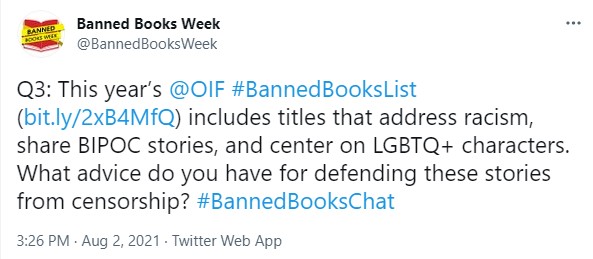
At the High School level, my September focus is on Banned Books Week and Library Card Signup Month. The theme for this year’s Banned Books Week is Books Unite Us, Censorship Divides Us. Jason Reynolds, Inaugural Honorary Chair of Banned Books Week, participated in a Twitter chat, #BannedBooksChat, on August 2, 2021. The chat is full of information about how librarians (and more) observe Banned Books Week in their schools. Question #3 of the #BannedBooksChat is a reminder that all school librarians need to review their requests for reconsideration policies and procedures should a book challenge arise. 


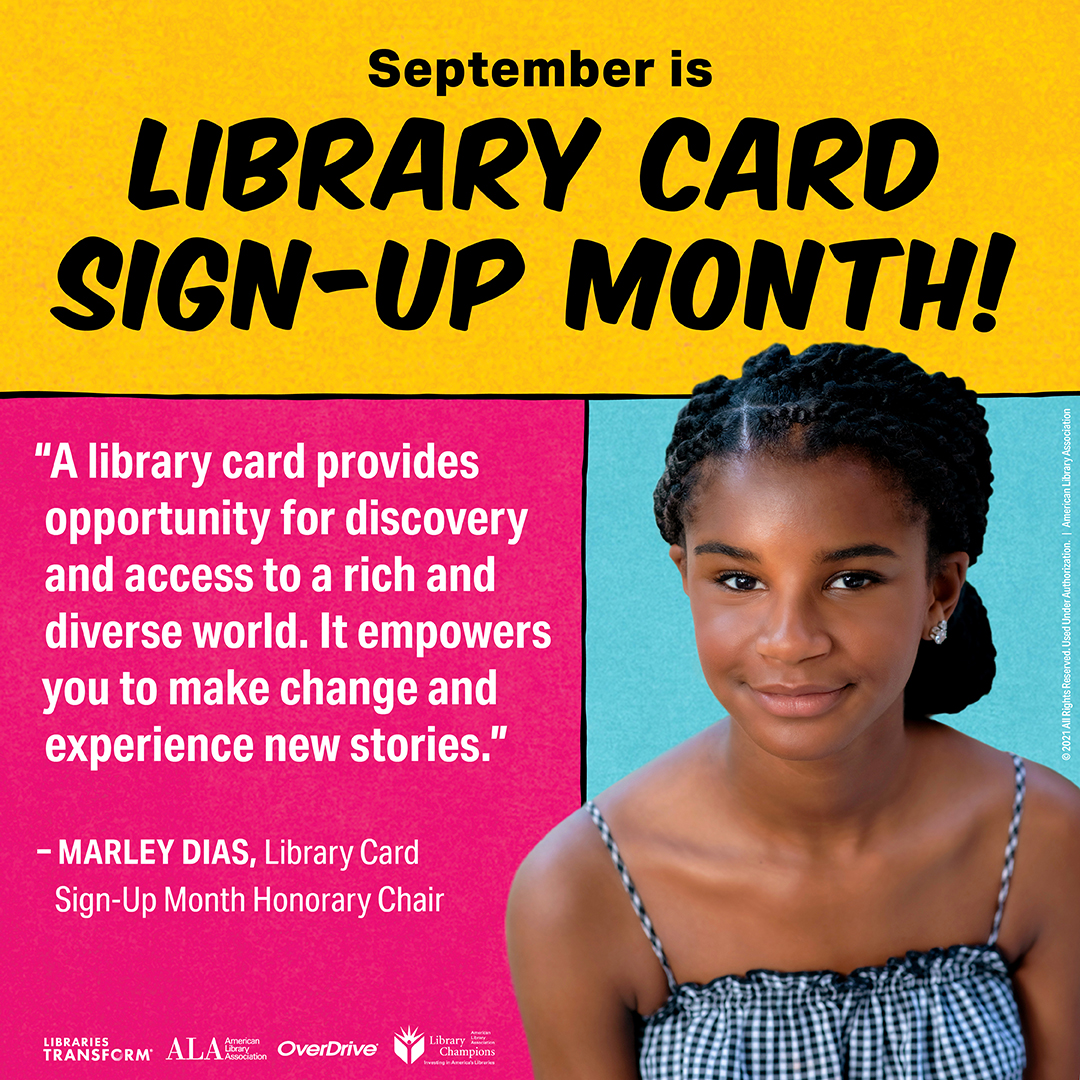
September is also the perfect time to partner with your public library for Library Card Signup Month. Many public libraries will come to your school and allow students to sign up for a public library card. Marley Davis, author, executive producer, and founder of #1000BlackGirlBooks is the honorary chair this year. It makes my heart sing to see her in this role! 


Although we have just dipped our toes into August the #LibraryCardSignUpMonth on Twitter is already generating buzz. Use #LibraryCardSignUpMonth on Twitter to access ideas from September 2020.  The American Library Association has provided free, downloadable, social media headers, covers, for you to use all month long. 


No matter the month, a visit to the library is always a reason to celebrate!


Monday, July 27, 2020

Ready For A New Year: The Power of Story


This blog post comes from my Closing Keynote 
for the Kansas Association of School Librarians 
after a month-long Canvas course.

Ready for a New Year-The Power of Story


Welcome! Welcome! I am excited to be here closing out KASL’s Summer Institute for School Librarians. 

Thank you to all of those who participated in the Canvas course, Building a School Library Program to be Proud of: The Power of Your Story. 

During the Canvas course, Building a School Library Program to be Proud of: The Power of Your Story we explored ways digital portfolios can be critical and powerful educational components that grow and develop with students throughout their lifetimes. Digital portfolios teach the importance of a positive digital footprint that has a consequential connection to each student, empower student voice & choice, allow for self-reflection, provide a deep and meaningful alternative grading component that goes far beyond reducing students down to mere numbers and letters, and most importantly, digital portfolios reflect and respect the whole child, their whole story. 

We looked into the vast wealth of professional learning available on Twitter, how to access this knowledge, and how to contribute to the conversation. The ability to harness the professional development potential of Twitter currently suits us well as the only consistency is the chaos of uncertainty. Times are, to say the least, crazy. Twitter also opens up an avenue to emotional and social support with those who ‘get us,’ who understand the particular needs and concerns exclusive to school librarians. 

In the words of Rafranz Davis, there is nothing that fuels the spirit like surrounding yourself with creative people who are willing to go to Camp Crazy with you! 


For me, the stories shared by KASL’s Summer Institute for School Librarians course participants demonstrate that what might seem like an obvious lesson, activity, or collaboration to you, is an amazing new discovery for others. Thank you to those who participated for cementing what I already know about our incredible library community; that we all have stories worthy of sharing with others.

The willingness of school librarians to freely share thoughts, ideas, plans, and more so that we can all learn and grow together makes this community stand out among all others. It was the power of our school librarian community on Twitter that picked me up, shook off the ashes and transformed me from a burned-out librarian waiting to retire to that of an invigorated and engaged school librarian eager to connect, share, learn, and grow so that I could bring the best our community has to offer to enhance student learning in my school. 

Even with support from our school library community, embarking on this new school year that lurks just around the corner is scary. Not the normal scary with nightmares about showing up on the first day of school in your underwear, but scary, scary. We are and have been in the midst of a very real and in your face crisis. It is now time as the school year begins in whatever form that looks like, to take a look at this crisis through a new lens. We have been granted a momentous opportunity to step up and demonstrate the invaluable need for school libraries and certified school librarians that may not have been appreciated to their fullest pre-COVID.  


What school will look like when it begins or throughout this next school year is uncertain. I suspect that many schools will see an ebb and flow between face-to-face, remote, or virtual or a blended hybrid of the two. 

Regardless of the way schooling proceeds this year, decision-makers must be aware of the importance of school librarians’ roles. We serve as leaders in classroom-library collaborations for both online and face-to-face instruction, we advocate to ensure students and families have access to physical and digital books, we serve as technology mentors and troubleshooters, provide virtual book club and other club sponsorship, we connect classrooms with the world, connect teachers, students, and parents with pertinent learning resources, provide professional development opportunities, and so much more.

The key to efficiently conveying the message of the expansive wealth of services offered by full-time, certified school librarians, is to clearly know and be able to communicate our WHY. Why are we essential to the school community both pre, current, and hopefully post COVID? This message must be clear, concise, and easily and quickly digestible, especially during this time of high stress when administrators and other stakeholders, and decision-makers are burdened with the concerns of all the educators, parents, and teachers they serve. 

School librarian Mary Chappell said, “If you value your job, you have to step up and prove you’re valuable.”


The State of America’s Libraries Report reveals that “more than 60 education and library research studies have produced clear evidence that school library programs staffed by qualified school librarians have a positive impact on student academic achievement”. Our administrators and other decision-makers simply do not have the time to review these over 60 research studies, even in their condensed form. In addition, these are reports from various states and schools but do not directly address what YOU are doing in YOUR school to positively impact student academic achievement. That is where we must step up and be able to demonstrate, document, and convey our worth.  

For school librarians who have consistently communicated their impact on student learning and continued to demonstrate and convey the essential services, they provided in the Spring when the ground shifted beneath us all, have solid grounds on which to advocate for their continued role in their schools’ academic program in the coming school year. 

One way school librarians can and have been communicating their impact on student academic achievement is through creating annual reports. Annual reports are a powerful storytelling tool that grabs the attention of administrators and other stakeholders. Annual reports share data beyond book circulation and class visits. Data that share how your work supports teachers and impacts student achievement.

I first learned about creating annual reports from Jennifer LaGarde, aka. Library Girl. She stressed and stresses the critical importance for school librarians to tell their stories with a bang through annual reports. 

Keys to a successful annual report include identifying your target audience, use data to connect the library to student achievement, diversify beyond numbers, charts, and graphs and use images and videos to tell the heartwarming stories of the social and emotional benefits of the library, start early by collecting evidence for the annual report throughout the school year, and look for and learn from annual reports designed by other school librarians. 

Jennifer Lagarde, on her blog, The Adventures of Library Girl, provides a collaborative Google Doc where school librarians have shared their annual reports. 

Next, after knowing and being able to communicate your WHY, is building relationships. It doesn’t matter how beautifully your library is decorated, how robust your resource collections are, all the cool interactives in your MakerSpace, or anything else if no one likes you. Recently on a school librarian’s Facebook group, I saw a librarian whose administrator had asked her to conduct her library classes in less than the conventional way in the new school year due to the mixture of remote, face to face, and blended learning we are all preparing for. Rather than finding a way to make this request work to her advantage and implanting positive connotations about school librarians in the memory of her administrator, this librarian dug her heels in, complained, and laid out a litany of what her “true” job duties are. 

There's a reason why negative stereotypes exist. 


I think Doug Johnson said it best, “As librarians, we can offer the very best hammer in the world, but if your principal, your teachers or your parents really need and want a wrench, a screwdriver or a hacksaw, having a hammer, no matter how wonderful, is simply immaterial. They get “it” that you have a great hammer - it just isn’t relevant or important to them. Even if you think it darned well should be.”


I implore you to always keep in the forefront of your mind that we are a service industry. Be more than just a hammer. Offer the whole toolbox and be willing to provide the services your patrons need.

Since the big COVID shakeup in the Spring, I have heard the term #NewNormal thrown around so I thought we would take this time to play a game. Grab something to write with and keep track of your answers. This game is called #NewNormal or #OldNormal. Here’s how it works. I am going to share two ideas from librarians of activities, lessons, projects, etc. Then you need to decide which one should be labeled #NewNormal and which should be labeled #OldNormal. 


Ok. Do you have all of your answers written down? Let’s reveal the answers and see how you did!

The answer is neither #NewNormal or #OldNormal. It is just plain and simply #NORMAL. 

You might be asking yourself, “How can what we faced in the Spring and what looms ahead in the new year be normal? I say emphatically, YES! NORMAL. All of these examples shown during the quiz can be done in any teaching environment … if we want to put forth the effort. Events like International Dot Day, Read Across America, World Read Aloud Day, Poem in Your Pocket, Mystery Skype, author visits, virtual debates, Techsperts, and many more where classrooms have expanded learning beyond the walls of the school building to connect students with real-world learning and global connections have been happening in our schools for YEARS and mostly at the prompting of the school librarian. School librarians have been teaching virtually ever since technologies emerged, making it possible to connect in this manner. School librarians, more than any other faculty member in our schools, are most prepared to lead the way in virtual, face to face, and blended learning landscapes.  

The saddest thing is that somewhere along the way, as the technological landscape shifted from equipment on rolling carts to software, websites, and apps, the perception of the librarian's role with new technologies took a drastic and damaging turn. 


The result has been the emergence of technology coaches, who are wonderful-don’t get me wrong- coupled with diminishing library positions and shrinking library budgets. Yes. Technology coaches are wonderful, but they are not librarians and cannot ever replace a full-time certified librarian. 

To do so would be equivalent to replacing space shuttle tiles with roofing shingles. "Kind of the same", but woefully inadequate to all those aboard the shuttle. 

We have been presented a very unique, and hopefully once on a lifetime opportunity, to step up and reclaim our place, to demonstrate our worth, and lead the way for our schools in whatever environment we find ourselves where teaching and learning take place. So as we come to an end and look out at the new year to come I want to leave you with this challenge: