Showing posts with label Professional Learning Network. Show all posts

Tuesday, April 25, 2017

Tracy Gargus Taylor: I Spy MakerSpace Activity


I just saw this post on Facebook's Future Ready Librarians Page and simply had to share.  

This was posted by Tracy Gargus Taylor:

I spent the last few weeks creating 3D and magazine collage I Spy boards and the rhymes/lists to go with each....

I used them today for the first time with k-6th grades. It was a huge success with classes....

I set up 4 areas in the room as centers. 

Each center had tables with two 3D “I Spy” boards, three collage type “I Spy” boards and 10 movie look and find posters. Each center also had a comfy area with a tub with 12 books (I Spy, Where’s Waldo, Can You See What I See?, Look and Find, Spot the difference, etc) and a bucket with 2 memory games and a Spot It game.

I had 4-8 kids in each center....they stayed in their center and used all of the items throughout class...with kindergarten I used the last 10 minutes as a whole group on the smartboard with an I Spy cd-rom game I got years ago from Scholastic.

I’ll leave the library set up this way this week and next and kids will go to a different center on their next visit (same materials just different things to find).

I think I’ll also use them for a family night next year....probably have them look at a board and write their own rhyme and list for it then switch with another family and try to find the items they wrote down.

Anyone have any other ideas to add to either the library centers or a family night?????


I also think it would be a great MakerSpace activity for the older, secondary ed students to create these for the younger, elementary ed students.

I absolutely love learning new ideas from my PLN! It's important that we all connect, share, learn & grow together!

Screenshot_6_24_15__7_34_PM_clipped_rev_2.png

Monday, April 10, 2017

School Library Live Twitter Chats Are Cropping Up All Over!


School Library Live Twitter chats are cropping up all over!

by Nikki Robertson and Jane Lofton
cross-posted on both of our blogs
(See this on Nikki’s blog at The True Adventures of a High School Librarian

School librarians are incredible networkers, and many have discovered that Twitter is one of the very best tools for building and benefiting from a personal learning network (PLN). Those of us taking advantage of Twitter for our PLNs never go a single day without learning some new ideas from our colleagues and those in related fields. And, Twitter live chats offer a kind of “booster shot” of Twitter goodness in a short amount of time, typically an hour.

If you aren’t familiar with what a live Twitter chat is, here’s are the basics:

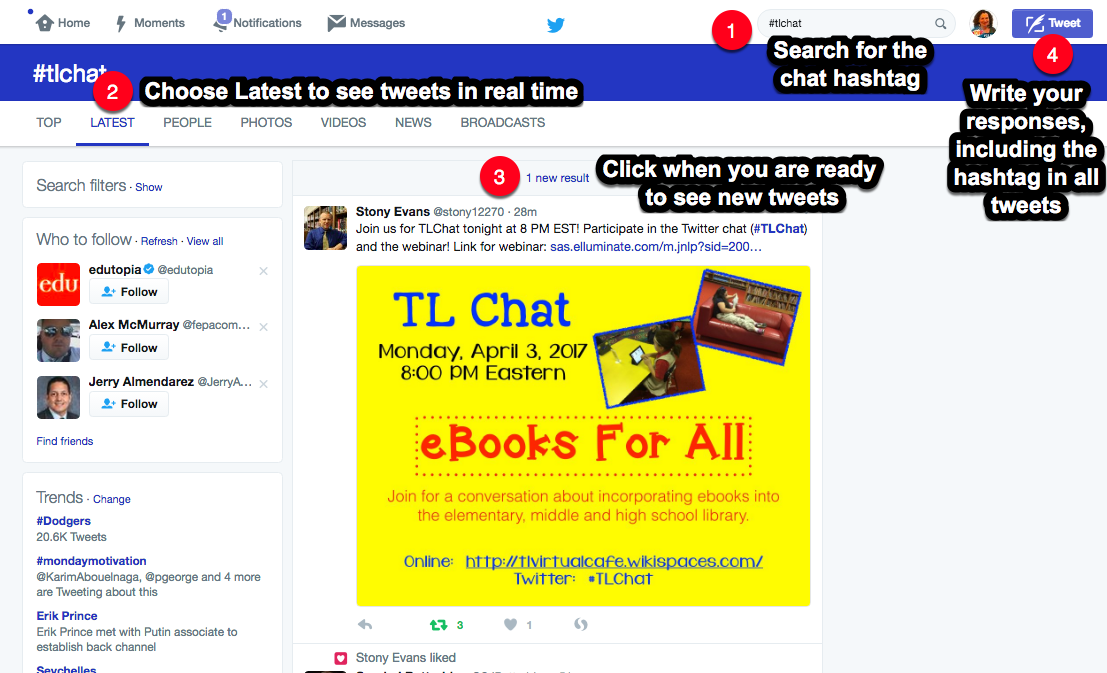
A live Twitter chat happens at an appointed/announced time. There is always a specific hashtag used to identify the chat. So, you can follow a chat by going to Twitter, searching for the hashtag, selecting Latest, and watching the tweets with that hashtag as people post. You join in by adding that hashtag to each of your own tweets.


Most live Twitter chats take place the same time each month or week. Each session will have a new theme or topic to discuss. Live chats typically have two moderators who prepare questions in advance and send the questions out during the chat. They start by asking everyone to introduce themselves. Then, they use Q1 for question #1, Q2 for question #2, and so on as a preface as they post the questions. The questions go out every few minutes. Participants start their responses with A1, A2, and so on. The participants can also interact directly with each other by responding to their posts. At the end, the moderators typically create an archive transcript of the chat so that people who missed the event or want to review it can visit a link and see the conversation.

We can't pretend that live chats are relaxing. They aren't! They are definitely a bit stressful, since you are going to see lots of tweets flying by at once while you are simultaneously trying to think and compose your own answers and comments. At the same time, they are amazingly stimulating, informative, and a great chance to interact in real time with your peers and discuss a topic of interest. We have connected with many new Twitter friends and gotten countless wonderful new ideas through chats. Just be prepared in advance that you can't read all the tweets in an active chat; you are bound to miss stuff, and that's okay. You aren’t even obliged to answer all the questions. And, feel free to lurk if you like until you are comfortable.

Educators of all kinds have started live Twitter chats in the last several years, for different subject areas, grade levels, states, regions, and much more. To find out about more chats you can participate in than you ever dreamed of, check Participate’s Chat site or Cybraryman’s Educational Hashtags. Until recently, though, there was just one live chat specifically for school librarians: #TLChat. The #TLChat hashtag is used by school librarians all the time as one of the main hashtags for targeting school library tweets, but, once a month, it becomes a live chat, now on the first Monday of the month at 8pm ET. And, joining it as a live chat platform recently are at least 10 state- or regionally-based school library chats. Here are the ones we know about:


And, ever generous as librarians are, we believe that all these chats welcome anyone. For example, you don’t have to be from New Jersey to participate in #NJLIBCHAT.

Also, notice that we listed the chats above in an embedded Google spreadsheet, since we are hoping we can add to it as we learn about more of them. Recently, Nikki created and sent out a Google Form in which she asked school librarians to share state school library Twitter chat sessions & hashtags. We got the information about the chats listed above from the responses to that form. If your state or region has a chat, and you don’t see it in the table, please complete the form and we’ll add it. And, if your state or region doesn’t have one, perhaps this will motivate you to start one!

We hope to see you at a chat soon!


Monday, December 19, 2016

Hour of Code: It Just Keeps Getting Better and Better!


Four years ago, December 2013, I learned about Hour of Code while laminating posters about the event for our computer science teachers.  At the time I had no idea what Hour of Code was, thinking it was just something for the vocational tech computer science teachers and their students.  The next year, after learning more about Hour of Code and our role as school librarians, I tackled Hour of Code spanning grades PreK through High School.  

Each year I have been impressed with the changes and improvements to the Hour of Code resources and inspired by seeing different approaches to Hour of Code shared by members of my PLN (Professional Learning Network), especially among my fellow school librarians.

This year my school set out for an Hour of Code record by having all 1800+ students participate in an Hour of Code unplugged activity .... AT THE SAME TIME!  We were able to accomplish this feat by using Advisory Time to our advantage.  Kristi Combs (Instructional Partner) and Allison Miller (Assistant Principal) lead a Flight School (our school's version of in school monthly PD) to prepare teachers for the big day.


In addition, teachers signed up to bring their classes to the JCHS Library Harvard Room to participate in more Hour of Code activities.  It was during these times that I stepped out on to that professional ledge of being willing to learn TOGETHER with the students as the impressive array of activities this year rivaled that of years past.

One of my favorite features this year was the ability to filter differently than in past years.  Instead of defaulting to the new block coding activity for the year I went out on a ledge and walked through the filtering process with students so that they could see what we were doing was age and subject appropriate.  Then we tackled these more complex coding activities together, emphasizing the need to collaborate and trouble shoot together.  

For our social studies classes that signed up we used the programming language Python and instruct a turtle to draw flags from around the world.  By far the favorite coding activity was when we coded our very own pixel character! We used HTML to build our characters, CSS to style them, and JavaScript to animate our cute pixel people.

Personally, my favorite activity was with our Special Education Self Contained students.  We created a graph on the floor of the Harvard Room using painter's tape and printed out START, END, TREATS, and MONSTER cards.  Ms. Jefferson was our robot.  DD students had to program Robot Jefferson using BeeBot direction cards to "write the code" that would get her from START to END, collect all the TREATS, and avoid all the MONSTERS.


So what are my tips and tricks for a successful Hour of Code at your school?

First, overcome your fear of not knowing how to code.  I had no idea what CSS and JavaScript were and had failed miserably in college trying to using Python to get the turtle to move!  The best part of Hour of Code is letting the kids work through the thinking process with you! This is actually one of the most valuable lessons we can teach our students on a daily basis, the thought process for working through a new problem and seeing that there are mistakes along the way.

Second, have a backup plan.  The first year I attempted to do Hour of Code was also the year many others got aboard and started doing Hour of Code as well.  This overloaded the Hour of Code website and caused many to be left stranded without access to the websites block coding activities.  This is when having an unplugged activity ready is key.  I'll admit that I was flying by the seat of my pants that first year and had no unplugged activity planned.  Sitting in a classroom filled with sixth graders when I realized the online activity planned was not going to work, I asked the kids for a dance they knew.  They had just learned Cotton Eyed Joe in PE so we decided to write out code a robot could follow to successfully complete the dance.  Several students volunteered to be our robots so we could catch the "bugs" in our code and correct them.  In the end, our robots were having an awesome time dancing!  We did a similar thing with PreK but used the Hokey Pokey as our dance.

Third, share your experience with others.  Sharing our experiences through social media, blogs, etc help us all learn and grow together through our collective experiences, PLUS it gives us an opportunity to celebrate the amazing learning going on in our schools and libraries.  Sharing isn't bragging; it's giving.

To see more from our Hour of Code 2016 click HERE to access our Google Photos Album.

I am also thrilled beyond belief to be headlining with the founder of Hour of Code, Hadi Partovi, at the Texas Library Association's Tech Camp in April 2017!


Thursday, July 10, 2014

The Making of an Incurably Curious Educator


My journey as an educator started in 1992 when I became a 5th and 6th grade teacher and continued as I became a school librarian in 1997.  The making, however, of an Incurably Curious Educator didn't happen until 2010 when I became disillusioned with the professional development I passively waited for my school district to spoon feed to me.  It was then that, what I truly believe to have been divine intervention, lead me to Shelly Terrell and her Teacher ReBoot Camp 30 Goals Challenge.  My life since then has been a whirlwind of change because, as the magnificient Maya Angelou said, 

“I did then what I knew how to do. Now that I know better, I do better.”


Now, as an Incurably Curious Educator, I have made it my mission in life to do as Shelly did for me, EMPOWER others around me, whether they be students, other educators, parents or community members, to be MASTERS OF THEIR OWN LEARNING.  


This insatiable curiousity has lead what I liken to a butterfly breaking free of it's cocoon, leaving confining, restrictive school districts behind as I spread my wings and head in the direction of new adventures.  These changes have been anything but comfortable or easy.  It reminds me of the Butterfly Struggle story:

Once a little boy was playing outdoors and found a fascinating caterpillar. He carefully picked it up and took it home to show his mother. He asked his mother if he could keep it, and she said he could if he would take good care of it.

The little boy got a large jar from his mother and put plants to eat, and a stick to climb on, in the jar. Every day he watched the caterpillar and brought it new plants to eat.

One day the caterpillar climbed up the stick and started acting strangely. The boy worriedly called his mother who came and understood that the caterpillar was creating a cocoon. The mother explained to the boy how the caterpillar was going to go through a metamorphosis and become a butterfly.

The little boy was thrilled to hear about the changes his caterpillar would go through. He watched every day, waiting for the butterfly to emerge. One day it happened, a small hole appeared in the cocoon and the butterfly started to struggle to come out.

At first the boy was excited, but soon he became concerned. The butterfly was struggling so hard to get out! It looked like it couldn’t break free! It looked desperate! It looked like it was making no progress!

The boy was so concerned he decided to help. He ran to get scissors, and then walked back (because he had learned not to run with scissors…). He snipped the cocoon to make the hole bigger and the butterfly quickly emerged!

As the butterfly came out the boy was surprised. It had a swollen body and small, shriveled wings. He continued to watch the butterfly expecting that, at any moment, the wings would dry out, enlarge and expand to support the swollen body. He knew that in time the body would shrink and the butterfly’s wings would expand.

            But neither happened!

The butterfly spent the rest of its life crawling around with a swollen body and shriveled wings.

It never was able to fly…

As the boy tried to figure out what had gone wrong his mother took him to talk to a scientist from a local college. He learned that the butterfly was SUPPOSED to struggle. In fact, the butterfly’s struggle to push its way through the tiny opening of the cocoon pushes the fluid out of its body and into its wings. Without the struggle, the butterfly would never, ever fly. The boy’s good intentions hurt the butterfly.


As you go through school, and life, keep in mind that struggling is an important part of any growth experience. In fact, it is the struggle that causes you to develop your ability to fly.


And now I find myself once again, like many in my PLN, changing courses and flying in a new direction.  Even though I hate leaving the most amazing school I have ever worked in and am "leaving" the library, I am excited about the possibilities my new position as an Instructional Technology Facilitator holds.  One thing I am not feeling, however, is fear because I know that I have the love and support of my PLN.  A PLN of amazing educators who truly understand the gift of empowering others on their journey.

If you are ready to spread your wings and venture into new, yet unexplored territory, please join me on my adventure.  I will be working with 3rd and 4th graders to help deploy a 1:1 initiative with MacBook Airs. We are looking for amazing, out of the box, higher level SAMR, opportunities for learning, collaborating and connecting with a global community.  


Tuesday, December 31, 2013

Put Your Twitter Glasses On and Bring Professional Learning Into Focus


One of my clearest childhood memories is when I got my first pair of glasses.  Back in those days there was no LensCrafters who could make your glasses while you wait.  As my mother drove me to the ophthalmologist to have my new glasses fitted I remember looking out the window wondering why I even needed glasses.  I could see just fine.  Once in the doctor's office I was asked to close my eyes as my new glasses were placed on me.  When I opened my eyes I was overwhelmed with emotions.  I saw things I had never seen before.  There were beautiful details that up until that moment I had been missing.  I spent the entire drive home mesmerized by everything I saw.


In a similar way, Twitter has been the glasses through which a whole world of professional learning has come into focus.  

From 1992 until 2008 I had been fairly confident that I knew what I was doing professionally.  I attended school district professional development sessions after all.  Certainly my district would keep me abreast of anything I really needed to know to be effective in my field…right?  Then in 2008 I attended my first technology conference.  As I looked over the concurrent session offerings I began to realize that there was quite a bit my district had not been sharing.  My curiosity was peaked.  I couldn't wait for the next technology conference to roll around again the next summer so I could learn more.  

By 2010 I was growing impatient for new information. How did the presenters at these conferences know what they knew? Did their school district provide better professional development than my school district? 

Then I started seeing QR Codes popping up in magazines.  I did a search to find out what they were and immediately thought, "This would be awesome to use in the classroom!"  I queried, "QR Codes in Education" and was incensed to find that LOTS of educators were not only using QR Codes in their classrooms but had been for several years.  Why had I never heard of them?  Why had my school district not offered any PD sessions about this?  Why had the last technology conference I attended not even mention QR Codes?  

Now I was angry.  What else was going on in education that I didn't know about?  I began searching for alternative means of professional development and came across Shelly Terrell's Teacher ReBoot Camp 30 Goals Challenge.  I printed out the entire free ebook and began going through the goals.  The "Make A Connection" goal was my Aha! moment. That pivotal moment that you look back on as significant and life changing.  This is the goal that introduced me to Twitter. Introduced me to the Twitter Chat, #edchat.  This is the goal that introduced me to Jerry Blumengarten, aka: @cybraryman1.   This is the goal that has propelled me to be the educator I am today.

This is the goal that also intimidated and overwhelmed me. As I connected with more and more educators from all around the nation it became glaringly apparent just how little I really knew about my profession.  I went from feeling confident in my abilities as an educator to feeling woefully inadequate. How would I ever be able to even get started doing the things Gwyneth Jones, Joyce Valenza, Doug Johnson, Kathy Schrock and so many others were doing?  One evening I sat crying and thinking that perhaps it would be best to just "collect a paycheck" and slide into retirement.  My school district wasn't offering PD in any of the new things I was learning about on Twitter so how was I supposed to learn all this new information anyway?  At 10:30 that evening I sent emails to several people I highly respected and had connected with on Twitter expressing my anxiety and fear from all of this new information and whether I should just stop trying.  I really never expected to hear back from any of them, after all, they were super star educators.  I woke up at 5:00 the next morning to get ready for work and on a hunch I checked my email.  Not expecting to find any responses I was floored to find that EVERY person I had emailed had emailed me back.  Every person gave words of encouragement and employed me to keep moving forward one step at a time but to never stop moving forward.  

THIS is why I am so loyal to building a 
professional learning network (PLN) with Twitter.  


Since that day I have kept moving forward and have never looked back.   I still feel inadequate at times, but that doesn't get me down because I know that I can always turn to my Twitter PLN for the best ideas. My PLN is enthusiastic, entertaining, engaging, informative, and more than anything…supportive.  They also make me look incredibly smart…"How does she know so much?!"

Many Twitter chats exist now because of people like Shelly and Jerry who have stepped out of their comfort zones and started Twitter chats to support their specific areas of education.  Joyce Valenza, Gwyneth Jones, and the dynamic TL Virtual Cafe Team created #tlchat specifically for school librarians to share ideas, get encouragement and to find avenues of collaboration.  

Not sure where to find your Twitter group?  Jerry Blumengarten can help.  Click HERE to access Jerry's Google Doc listing Twitter chats by day and time.

Don't see a chat that suits your niche? Step out! Be bold! Create one! (Goal 7: Step Out Of Your Comfort Zone)

Not sure how to use Twitter?  Your district doesn't offer PD on Twitter? Your district blocks Twitter so why try?  

Stop making excuses! 

Stop waiting for someone to teach you how to do new things (Hello…there are YouTube Tutorials for almost anything) 

Stop waiting for permission!   

Don't let anything or anyone (even you) stop you from connecting, sharing, learning, and growing and bringing that information and enthusiasm back to your students!  


More:


Wednesday, September 25, 2013

GISL: Developing Your PLN at an Exponential Rate...with Twitter!


Click on pic above to access Google Presentation


Tomorrow (9/26/2013) at around 10:30 ET I have the great pleasure of  meeting the Georgia Independent School Librarians (GISL)  virtually and sharing how to build a Professional Learning Network (PLN) with Twitter.

I will be meeting with the members of GISL via Google Hangouts On Air.  The LIVE broadcast and subsequent recording will appear below:


We lost our signal during the original broadcast, but no worries...we started over! Part 2 is below.

.


Sunday, June 30, 2013

Twitter: It's All About Relationships


Recently my friend, #EduSister and EdCamp Atlanta Co Organizer, Jaime Vandergrift, wrote a blog post entitled, Playing the Numbers Game-The Truth About Followers, in which she explored the topic of connections made on Twitter which of course got me thinking about the great relationships I have formed through Twitter and the overall importance of relationship building through social media, specifically Twitter.

As educators we already know that the relationships we build with students contribute more to student success than any technology or teaching method we employ in our classrooms.  


Just as important as relationship building inside the four walls of your classroom is the building of professional relationships outside of your school, outside of your school district, and beyond your state, to the global community we are preparing students to enter.  One of the best ways to build these relationships is through Twitter.  

As a self proclaimed Twitaholic or Twivangelist, I am constantly emphasizing the importance of building a Professional Learning Network (PLN) through Twitter.  Simply setting up a Twitter account isn't enough.  You must make a concerted effort to find others who inspire, uplift and encourage and be willing to do the same in return.  

Eric Kuhn, head of social media at the famed United Talent Agency, advises that a good social media person is someone who is "authentic" and "transparent." The thought of being transparent is a hard concept for many educators to grasp.  Educators who are resistant to social media always state with fear in their voice, "Someone will see what I say".  Wonderful I say! Someone should see what you say! You are an amazing educator and only the few students who pass through your classroom/school know anything about the things you do. Wouldn't it be wonderful to share what you do with the world so that other teachers can learn from you and share those lessons with their students?  Then image what you could learn from other educators that you never even imagined possible in your classroom.  

Two of my self appointed online mentors make the importance of transparency and sharing what we do in our classrooms crystal clear.  Gwyneth Jones, aka The Daring Librarian, wrote about transparency in her blog post, Transparency is the New Black.  She states, "Now, more than ever, education professionals must be visible and transparent in what they do and with their program and practice."  Jennifer LaGarde, aka Library Girl, spoke to a group of new Alabama Librarians on June 9, 2013 at the Alabama School Library Association pre conference for new librarians about the importance of sharing and not being a Zombie Librarian.  Jennifer's message to new librarians rings true for all education professionals from classroom teachers, to librarians  to administrators.  Parents, administrators, school board members, the mayor, state legislators and politicians who continuously attack educators will never know just how valuable we are unless we speak up and share, share, share.  Don't be a Zombie Educator!

The video, Obvious To You. Amazing to Others, points out the importance of sharing through blogging.  It can equally be applied to Twitter as Twitter is a micro blog.


Principal Eric Sheninger drives home the importance of being a connected educator and sharing in his blog post, Connectedness as the Standard.  Eric states and I agree, "In my opinion, being a connected learner, leader, and/or educator is no longer an option.  When I think back to my life as an educator prior to becoming connected, I can honestly say that I was isolated, naive, and definitely not as well rounded as I am today."  In fact, I take it one step further.  When I meet a new educator one of the first things I do is search to see if they are connected on Twitter.  If not, my opinion of them drops. Why? Because I know that this educator is only as great as the sum of their own personal experiences.  Because they are not connected they have failed to harnessed the power, experience and wisdom of the minds of innovative educators from all over the world and bring that knowledge back into their classroom, thus providing the richest of learning environments for their students.  

So what does all this sharing have to do with building relationships?  EVERYTHING!  When you connect with others on Twitter and share the amazing things you are doing with students EVERYONE learns and grows exponentially and relationships are formed.  Imagine connecting on Twitter with a class in another state or country to work on a collaborative project together.  Students not only learn the basic objectives of the lesson, they also learn the value of collaboration, the importance of making global connections and how to be a good digital citizen.  

Start connecting, sharing, learning and growing today.  Find a hashtag so that you can engage in conversation with educators who are passionate about the same things you are passionate about.  A few of the main hashtags I use to connect include: #TLChat, #ALEdChat, and #EdChat.  The relationships formed through conversations that started with just a 140 characters on Twitter have transformed my life.  

In the words of Dr. Seuss from the book, Marvin K Mooney Will You Please Go Now, "The time has come. The time is now." Get connected. You will be amazed with the person you become. 


Wednesday, May 29, 2013

Blogging + ePortfolios = Reflection & Growth


Obvious to you. Amazing to others. - by Derek Sivers


The end of a school year is the perfect time to spruce up your ePortfolio and catch up blogging about your successes and trials this school year.  Haven't started an ePortfolio or blog?  Use this summer to get started!

I first embarked on blogging as part of Shelly Terrell's Teacher ReBoot Camp 30 Goals Challenge.  I couldn't even begin to image why I needed to blog.  I thought, "Certainly no one will want to read anything I write".  Then I realized that I didn't need to blog for anyone but myself.  My blog was my own personal reflection tool where I could write about successes and trials and examine them "out loud".  

Think back to your student teaching experience or, if like me it's been too long to remember that far back, review what student teacher interns must do-REFLECTIONS, REFLECTIONS, REFLECTIONS.  Student teachers must reflect on absolutely every aspect of their teaching experience so that they can learn from their time in the classroom.  Why then do we as educators stop this reflection as soon as we obtain our teaching certification and step foot in our classroom, closing the door behind us?  Isn't this when we should be reflecting even more?  

What I have discovered now almost four years into my blogging journey is that not only have I learned through reflecting while writing my blog posts but I have learned from others who have read and responded to my blog.  Other educators have offered ideas and suggestions for how to approach a lesson, presentation, etc in ways I would have never thought of on my own.  I am so grateful for the awesome PLN (professional learning network) that began with my timid steps into the world of blogging.


Professional ePortfolios add another layer of reflection to the mix.  ePortfolios provide educators an opportunity to demonstrate individuality that is as unique as a fingerprint. 

*The benefits of creating an ePortfolio include:
  • demonstrates effort, progress, and achievement
  • makes connections between theory and practice
  • documents your learning progress over time
  • provides evidence of meeting professional standards
  • enhances communication and organizational skills
  • greater awareness of strengths and weaknesses
  • encourages reflective self-inquiry
  • illustrates good teaching
  • supports professional growth
  • leads to goal planning
  • visible collection of skills to present to a prospective employer
  • celebrate accomplishments
  • improves teaching
  • often considered authentic assessment
*http://bit.ly/12haJun

This summer I am presenting a three hour hands on session at AETC (Alabama Educational Technology Conference) on ePortfolios for both students and teachers.  In preparation I have taken a closer look at my own ePortfolio.  While I like the areas I have chosen to highlight - Presentations, Publications, & Honors, I have overlooked one of the most important components in an ePortfolio; reflections.  That is, for each link included in my ePortfolio I should also have, even if brief,  a reflection about the presentation, publication, honor, event, etc.   Adding this component is one of my summer goals.  

Through blogging and maintaining an ePortfolio I am able to reflect, learn and grow and more importantly share and learn from others.  


Get your own blog and ePortfolio started TODAY! 

I'm a Pinterest freak! Check out my Pinterest board on ePortfolios.  I have also compiled a great list of library/book blogs.


Please share shamelessly! (Quote stolen form the amazing Gwyneth Jones aka: The Daring Librarian)


Tuesday, April 2, 2013

STOP Fighting the Change.... Be the Change!


Have you ever had the same topic continue to pop up in your life over and over again until you just can't ignore that the universe is kicking you in the pants?  This is what has been happening to me for the past few weeks.  I have tried to ignore it to no avail.  OK, Universe!  I surrender!


Universe Kick in the Pants- #1

It started in my principal's office during my observation  review.  My principal, Dr. Freeman, mentioned reading Daniel Pink's newest book, To Sell is Human, and mentioned Daniel Pink's statements about teachers and the art of selling; that teachers are no longer the dispensers of information but need to be the motivators that can “sell” students on what they’re learning,   A change in thinking about the way we educate needs to happen.


Universe Kick in the Pants- #2

Later that week I was on Twitter participating in the #teach2030 chat and mentioned Daniel Pink's philosophy on selling and education.  One educator fundamentally disagreed with me basically stating that his students were to stupid to be trusted with ownership of their own learning. I stated that he underestimated his students.  It burned me for the rest of the night that this educator has such a negative view of his students. This educator needs to change his attitude or get out of education.


Universe Kick in the Pants- #3

Next, I was contacted and asked if I would present a session on the Flipped Classroom for the Alabama Education Association CEU/PLU Conference.  The hot topic of conversation at the conference was about House Bill 84 that would provide vouchers for private schools. I have been a member of AEA for 21 years.  AEA has been a great advocate for educators in my state and have personally assisted me for which I am forever thankful.  While preparing for my presentation at this conference about the Flipped Classroom it became more and more apparent the urgent need for change.  At the last minute I added some changes to my presentation that I just felt couldn't be ignored, even if considered controversial or even traitorous in the union environment. 


First, I discussed how schools can begin embracing the change that community stakeholders are demanding, starting with individualized learning plans for every student; one of Daniel Pink's main statements about where education needs to go to remain relevant.  Surprising to me, this topic came up in our new high school planning meetings.  When I signed on to be a part of the new high school planning committee I thought we would discuss architectural aspects of the new school. What we really discussed was the future of education, individualized learning, space for differentiated classes, experiential learning environments, and other concepts not seen in a "typical" public school but more and more often found in private and charter schools. I added both this discussion and Iowa's plan to teach kids at their own pace to my AEA Presentation.  


Second, I broached the very touchy subject of charter schools, private schools and vouchers.  This subject was front and center during the AEA Conference with fiery speeches railing against the voucher system.  While I support my union, I also know that vouchers, charter and private schools are not going away.  Fighting against vouchers, charter and private schools may delay the change but will not stop the change.   Community stakeholders are going to continue to demand a better education for their children and if that means moving out of the public school sphere, so be it. On February 14, 2013 President Obama visited Decatur Schools in Georgia.  Decatur recently moved from a traditional public school system to a 100% Charter School System due to the demands of community stakeholders.  A friend of mine sold her house and moved to Decatur just so her daughter can attend these charter schools.  My suggestions to my fellow AEA members is to stop fighting against the changes.  Rather, I propose they embrace change to create schools that meet the demands of their stakeholders thus rendering private or charter schools moot in their communities.


It is my belief that the Flipped Classroom is one way teachers can begin to make the changes that our community stakeholders are demanding.  The Flipped Classroom allows teachers to move outside of their comfort zones, work with students on a one to one basis, and provide opportunities to apply higher order thinking skills rather than rote memorization.  I like to use the "How Do You Eat An Elephant" analogy when introducing this concept to teachers.  Teachers can start using the Flipped Classroom module or a modified version of the Flipped Classroom in small increments. Try a lesson with one class with one lesson.  See how it goes, make improvements, and try again with another class and another lesson.


Universe Kick in the Pants- #4

When I returned from the AEA CEU/PLE Conference I stumbled across a great online PD opportunity  offered by the amazing Shannon Miller in partnership with the School Library Journal entitled, Be the Change.


Universe Kick in the Pants- #5

The final straw that broke the camels back and made me have to get serious and write about-Be the Change, was the Atlanta City School cheating scandal splashed across the headlines.  Again, as Daniel Pink states, “Most of our education is heavily, heavily, heavily standardized.  So, 11-year-olds are all together in one room. No 10-year-olds, and certainly no 13-year-olds. And [assuming that] all of those 11-year-olds are the same, we’re going to put them all together in a 35-kid classroom. Every educator knows that doesn't work well."  What the teachers and administrators failed to realize when they got sucked into this awful cheating scandal brought on by a seriously flawed system of standardized testing was that when you embrace the changes that private and charter schools have embraced and that Daniel Pink addresses success on standardized testing takes care of itself even if you haven't spend one day "teaching the test".


Early in my teaching career I actually had a superintendent who forbid any form of teaching that was not "teaching to the test".   One poor teacher got yelled and cursed at by this superintendent the day before Christmas Break (he was known for walking into classrooms, railing on teachers and throwing dollar bills at the kids each time he said a curse word).  She was doing an activity with her 5th grade students where they had to build their own gingerbread houses.  This activity included measuring as well as reading and following directions, but because it was not in "test format" (aka: a bubble sheet) this activity was not allowed.


So the looming question is, How Can YOU Be The Change?  The Flipped Class is certainly one way to get started.


Below I have listed some other suggestions for how you can Be The Change.


  • Change your attitude.  Embrace change. Think the best of your students.  Believe in empowering yourself and your students to reach great heights.
  • Look for professional growth opportunities. Stop waiting for your school district to bring professional learning to you, seek it out on your own.  The best thing we can teach and model for our students is how to learn. 
  • Build a PLN (Professional Learning Network), 
  • Attend conferences not sponsored by your school district like an EdCamp Event (my favorite type of PD!),
  • Find both free and paid webinar opportunities. 
    •  As a school librarian, I love the TL Virtual Cafe's monthly webinar series and the monthly #TLChat Twitter sessions.
    • The amazing Shannon Miller in conjunction with the School Library Journal is currently providing webinar opportunities in leadership. 
    • Classroom 2.0 provides a broader range of learning opportunities for those of you who are not librarians
    • Simple K12 is a great paid for website for quality online professional development.  They have free Days of Learning so that you can sample some of their great presentations.  
    • For a full listing of educational webinar sites available check out Cybraryman's Site!
  • Write a blog.  Take a look at student teacher interns.  What is the one thing they have to do to Ad nauseam?  REFLECTIONS!  Student teachers must constantly reflect on every aspect of their teaching, their lessons, their interactions with students, their interactions with other teachers, their planning of lessons, their use of technology, etc, etc, etc.  Why is it AFTER we start teaching we stop reflecting?  A blog is the perfect way to reflect on your teaching as well as a way to learn and share with others in your field as you build your PLN.


Be The Change!


Click on image above to access my AEA presentation.